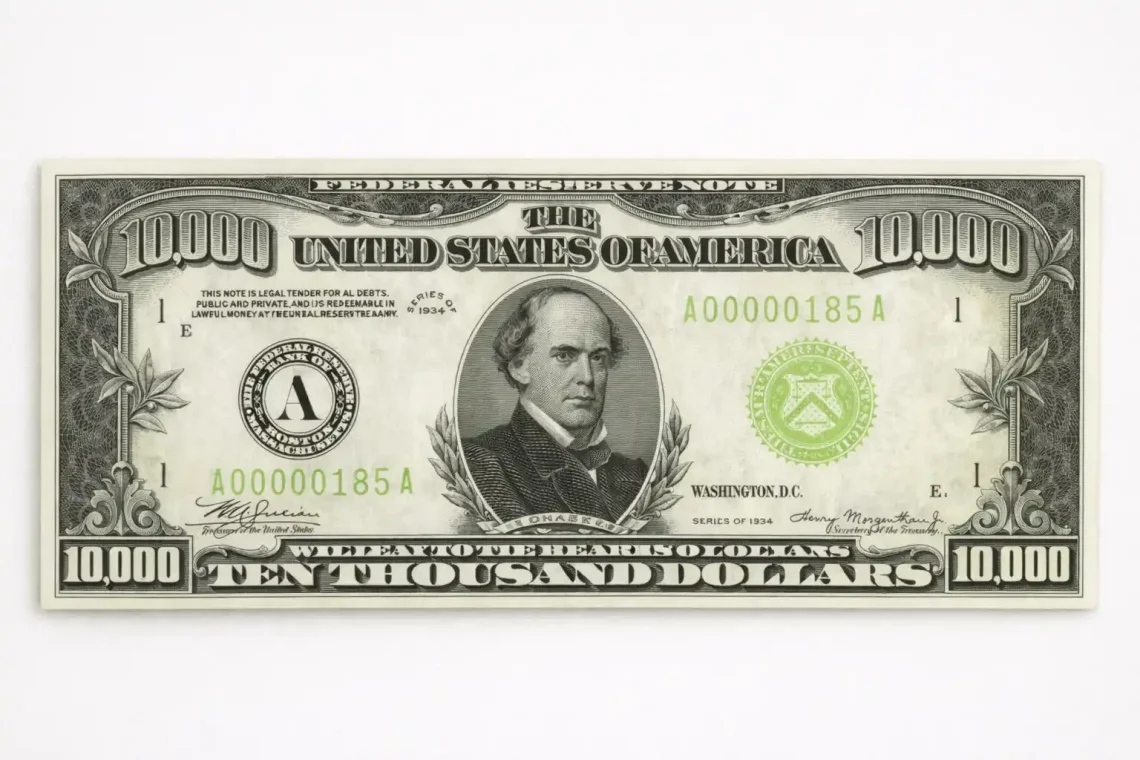
A $10000 bill is the kind of note people notice before they understand it. The face value is famous. The note itself is harder to read. A collector does not start with a big number. A collector starts with the paper, the series, the signatures, and the condition. That is where the real judgment begins.
The $10,000 note was the highest denomination ever issued for public circulation in the United States. It was printed for large transfers, not for ordinary retail use. The denomination was discontinued in 1969 because it was no longer needed in modern banking, and the last printing had already taken place in 1945. Those facts explain the note’s reputation. They do not explain how to read one correctly.
Quick Overview of the $10,000 Bill
Before looking at quality, a collector should identify the basic frame of the note.
Feature
Basic point
Denomination
$10,000
Portrait
Salmon P. Chase
Public role
Large transfers, not daily spending
Main collector focus
Series, paper quality, originality
Modern status
Discontinued in 1969
The portrait is of Salmon P. Chase. The denomination is extreme, but the reading method is not exotic. It is still paper money. The same core habits apply: classify the issue, study the paper, inspect the margins, and look for any sign that the note has been worked on. The higher the denomination, the less room there is for loose reading.
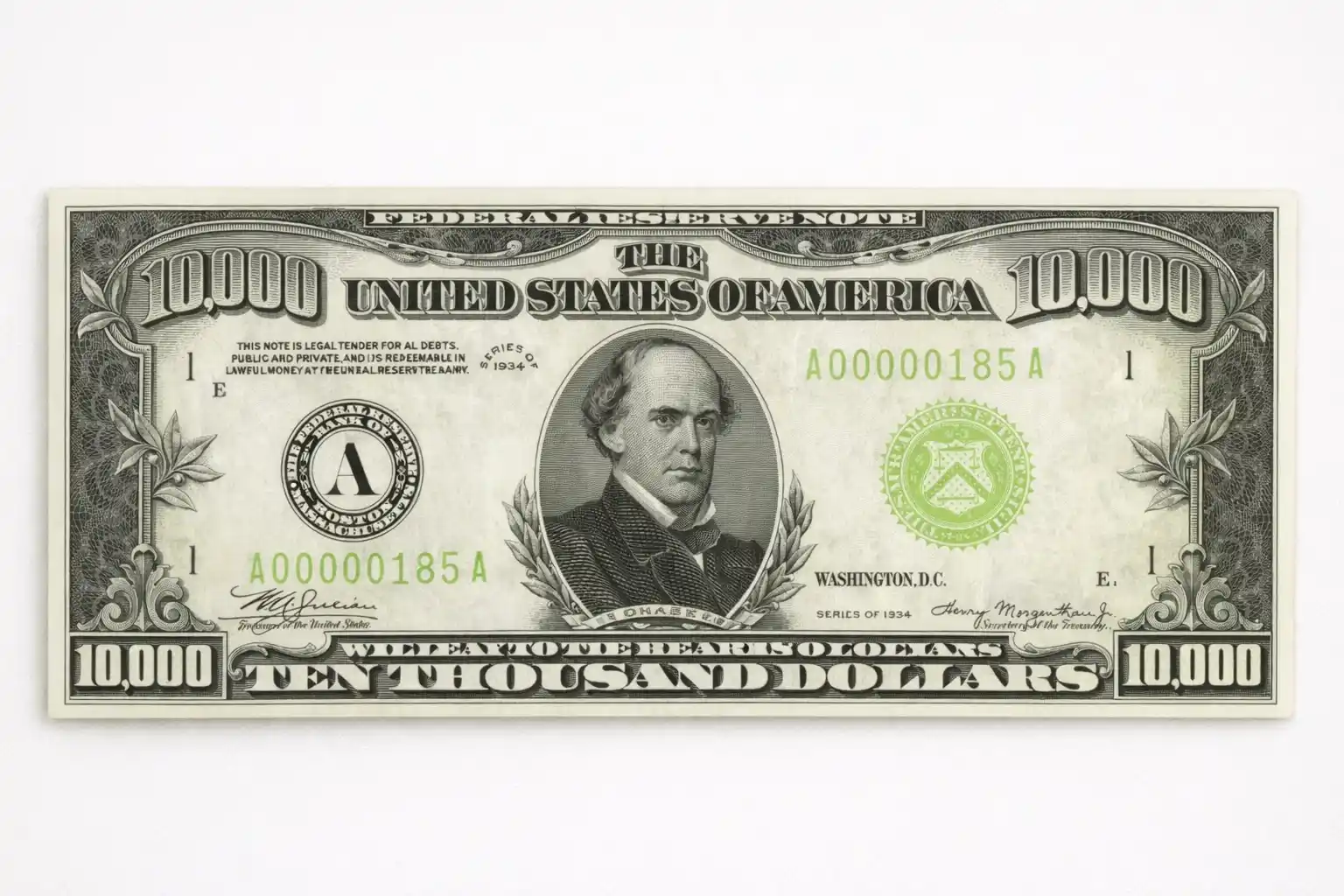
Alt: Front of a $10,000 bill with Salmon P. Chase on a light background.
Why Numismatists Read the Note Before the Price
A famous note can still be a weak example. A lesser-known example can still be the better collector piece. That is why specialists do not begin with price headlines. They begin with structure.
What they read first:
Series line
Signature pairing
Paper body
Fold pattern
Margins and edges
Signs of repair or pressing
That order matters because price follows confidence. Confidence comes from correct reading. A buyer who skips the note and jumps to the number is already behind. The denomination gets attention. The details decide the market level.
Start With the Series
The series line is the first anchor. It tells you which kind of $10,000 note you are looking at, and it tells you what comparison is valid. A 1918 note is not read like a 1928 note. A 1928 note is not read like a 1934 note. Even before the condition, this matters.
Series
Main type
What stands out
1918
Federal Reserve note
Blue seal, Pilgrims vignette on reverse
1928
Federal Reserve note
Small size, gold redemption text
1934
Federal Reserve note
Small size, lawful money text
The 1918 note is the large-size blue-seal Federal Reserve Note. The back shows “The Embarkation of the Pilgrims.” The 1928 and 1934 notes are small-size Federal Reserve Notes with Salmon P. Chase on the face, but the text block changes. The 1928 note includes gold redemption wording. The 1934 note uses legal-tender and lawful-money wording. These are not decorative differences. They place the note correctly.
A collector should ask simple questions here:
Does the series match the note type
Does the text block fit the expected issue
Does the seal color make sense
Does the overall layout fit the stated series
That is the base layer. Without it, everything that follows becomes weaker.
Signatures Are Part of the Identity
Beginners often glance past the signatures. Specialists do not. On a note of this level, the signature pairing is part of the identification. It helps place the note inside the correct issue framework, and it helps the buyer avoid bad comparisons.
What signatures help confirm:
Issue context
Expected pairing
Printing period
Correct identity of the note
This does not mean every collector must memorize every signature combination. It means the signatures should never be treated as dead space. A note with the right portrait and the wrong comparison set can still be misunderstood if the signature pairing is ignored. On a high-denomination note, small printed details carry more weight than many new buyers expect.
Condition Is More Than “Nice” or “Used”
Paper money condition needs more than a quick glance. A $10,000 bill is not read by brightness alone. It is read by paper body, fold count, corners, margins, stains, and overall balance. Two notes can look similar in a casual image and still sit in very different collector categories.
Area
What to inspect
Paper body
Firmness, crispness, fatigue
Corners
Sharpness or rounding
Folds
Number, depth, visibility
Margins
Balance and cut quality
Surface
Stains, handling, discoloration
PMG’s grading scale is useful here because it ties visual signs to market language. Uncirculated notes may still show handling, corner-tip issues, or imperfect centering, but they should not have folds through the design.
About Uncirculated notes can have one fold or a few corner folds. Lower grades show more folds, more softness, rounded corners, margin splits, and stronger circulation evidence. That is why “looks clean” is not enough. Paper money has to be read feature by feature.
A practical reading order helps:
Check the paper body first
Count folds second
Look at the corners next
Study margins after that
Finish with stains, marks, and handling traces
That sequence keeps the eye from being distracted by the denomination.
Original Paper Versus Worked-On Paper
This is where many expensive notes rise or fall. A note can look fresh and still be a problem. Pressing, washing, repair work, trimming, and other forms of improvement can change the note’s market trust. High-denomination notes are not judged only on how clean they look. They are judged on whether the paper still feels original.
The original paper usually shows:
Natural body
Believable wear
Honest texture
Stable surface tone
Worked-on paper often suggests:
Paper that looks too flat
Unnatural brightness
Surface that feels processed
Wear that does not match the rest of the note
That does not mean every bright note is bad. It means the paper must make sense as a whole. A note that looks improved can still be collectible, but it will not be read in the same way as a note with stronger originality.
The Red Flags That Change the Whole Reading
Market red flags do not always mean forgery. Often, they mean caution. They can point to restoration, hidden problems, weak description, or a note that needs better documentation before it deserves stronger trust.
Common red flags include:
Suspicious paper texture
Strange brightness
Uneven margins
Signs of pressing
Repairs at folds or edges
Selective or weak photos
Incomplete listing details
A careful buyer reads those signs before reading the price tag. High-denomination notes sit in a narrow market. Buyers do not want surprises. A note with a clear, honest presentation is easier to place. A note with selective angles, vague wording, or obvious paper concerns becomes harder to trust.
How to Inspect the Note in a Practical Order
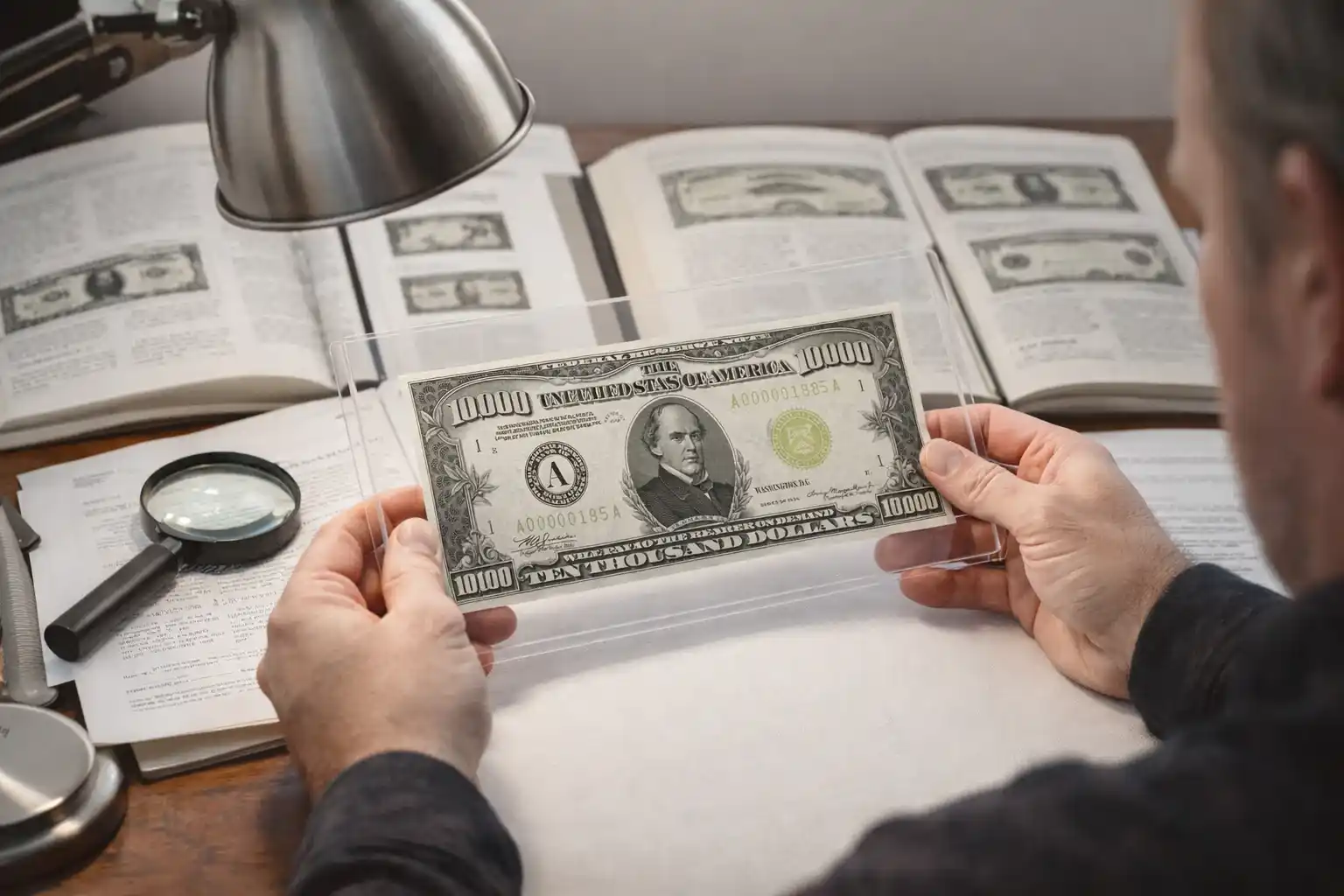
A strong inspection routine keeps the process calm and clear. On a note like this, random-looking is not enough. The buyer needs a fixed sequence.
A useful order looks like this:
Read the note as a whole
Check the series line
Confirm the signature pairing
Study the paper body
Count folds and handling signs
Review corners, margins, and edges
Look for repairs, trimming, or pressing
Compare only after the note is classified
That sequence does two things. It prevents overreaction to the denomination, and it reduces the chance of comparing the wrong note to the wrong market examples.
Where a Quick Digital Shortcut Stops Helping
Some collectors rely on a coin checker when they want a fast digital reference for numismatic material. That habit makes sense when the goal is quick orientation. It does not carry very far with a $10,000 bill.
A shortcut can help with broad familiarity. It cannot replace note-specific reading. On a high-denomination banknote, the real work is not just identification. It is classification, condition reading, and paper judgment. A digital shortcut may point you toward the type. It will not read the paper body for you. It will not judge the margin balance. It will not tell you whether a note feels original or improved.
That is why quick lookup behavior has limits here. The larger and rarer the note, the less useful a shortcut becomes on its own.
Market Trust Comes From Detail
Collectors do not buy these notes because the denomination is dramatic. They buy them because the note makes sense. Trust grows from alignment between the visible details and the expected issue.
Factor
Why the market cares
Correct series reading
Supports proper comparison
Signature pairing
Confirms issue context
Paper originality
Supports trust
Clear margins and folds
Strengthens condition reading
Honest presentation
Reduces uncertainty
This is the real market logic. One note may be famous, but another may be safer, stronger, and more desirable because it reads better. On major paper money, details do not decorate the note. They create the market.
Conclusion
A $10,000 bill should not be read like a headline object. It should be read like paper money. Series first. Signatures next. Then, condition, originality, and warning signs. That is how a numismatist separates a famous note from a well-understood note.
Try the free coin value app for yourself when you want a quick numismatic answer. A tool like Coin ID Scanner, with its AI assistant, can be useful as a general hobby reference on the coin side. A $10,000 bill still demands note-specific reading. The final judgment comes from the paper, not from the shortcut.